Step by Step instructions on how to use heat transfer to create t-shirts and custom projects with tips and tricks for perfect application.
Read on to hear what I have learned along the way on Heat Transfer Vinyl, but first, let me make sure you know about my Silhouette 101 series! I have been putting together all of my most asked questions, and favorite tips and tricks I have learned along the way in this series! You can see all of the posts here on the Silhouette 101 page. Now before we start, make sure to do two important things:
- Sign up for my Crafty Newsletter! This will deliver all crafting posts including each new Silhouette 101 tutorial right to your inbox as they are released, so you don’t miss a thing! Sign up here!!
- Pin the Silhouette 101 page to your Silhouette or craft board on Pinterest (and make sure to follow me while you are there!) Now, if you are crafting and have questions, you have an easy place to find this post and a place to reference for all of your questions! You can repin the Silhouette 101 pin here!
I remember in the 80’s my mom making me t-shirt dresses. I loved them! When I was really lucky she would also buy these cool designs at the store that she could just iron on so I could rock my metallic butterflies and horses right on the front of the dress. Well… that fad came and went, but what is still pretty darn awesome is being able to customize any project you make with fabric. We have come a long way since the 80’s, and with my Silhouette Cameo I am now able to use Heat Transfer to cut any design, monogram, team logo, party design, etc. and add it to the front of a shirt, a bag, a pillow, or pretty much anything that can be ironed.
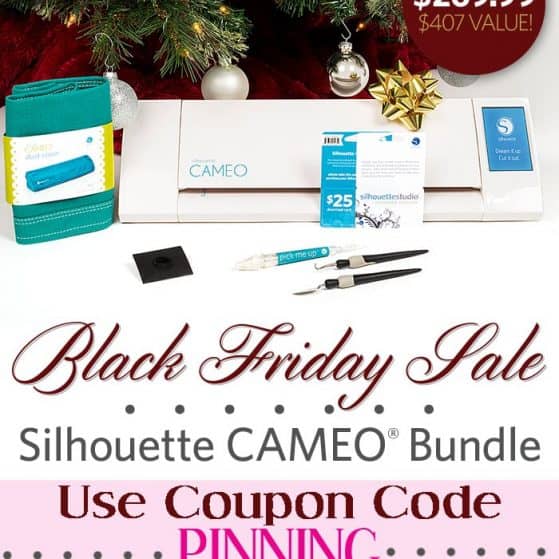
This has actually become one of my favorite uses for my Cameo and I have quite the collection of projects I have created with it. It is pretty easy to do, however there were a few tips I picked up along the way I am going to share with you so you can skip the learning curve I went though and make your projects perfect from try 1! Just consider this The Beginners Guide to Heat Transfer Projects! Oh and if you think this is pretty much the coolest thing ever {like me} make sure and scroll past the tutorial for an awesome sale on all Heat Transfer Materials and Silhouette Cameo and Silhouette Portrait Machine Bundles with promo code PINNING.
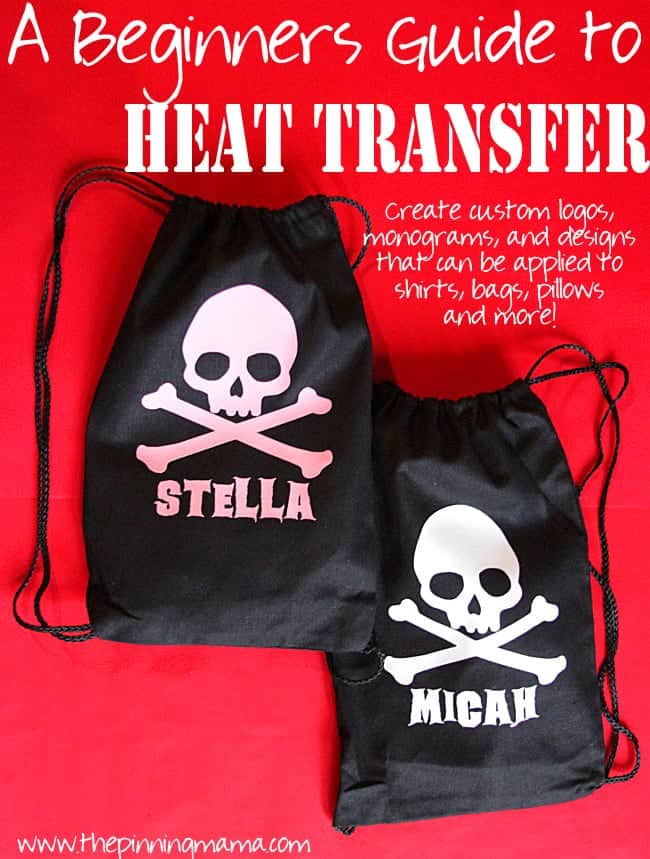
So for simplicities sake, we will just walk though this project and talk step by step how you would make it, with all the tips and tricks you really want to know as they apply along the way. These are the party favor bags I made for my son’s pirate themed birthday party. You can see the details on where I ordered them and all the goodies I filled them with here. So let’s just start with tip number one.
1. What can I use heat transfer on? Anything you can iron on with a very HOT iron. When picking out these backpacks I found many options made out of synthetic material but I was afraid that the hot iron would melt it, so I went with canvas. The heat transfer will be ironed on with one of the irons hottest settings so make sure your fabric can withstand that heat. It is also helpful to PRE-WASH your project if it is something that will be washed. I found that if you don’t prewash, then the shirt (or project) can pull a little from shrinking around the heat transfer material if it is washed for the first time after the heat transfer is applied. If it isn’t something you will be washing (like these backpacks) no need to worry about this step!
2. What kinds of heat transfer material are available?
Silhouette Brand Heat Transfer Material: You can get heat transfer in MANY types of styles and finishes. There is smooth heat transfer which comes in matte, glossy, and even glitter. You can also get flocked heat transfer which has a thin coat of flocking making the front soft and fuzzy. Lastly, you can get printable heat transfer for dark fabrics or light fabrics, that allows you to print your own designs, cut them out and transfer them on your project. This is perfect for really intricate designs with lots of colors!
Other Heat Transfer Vinyl Options: There are many other options beyond just Silhouette Brand for Heat Transfer vinyl. Many people love Siser Easyweed HTV (Heat Transfer Vinyl.) They have starter packs as well as a really wide variety of options when it comes to colors. They also sell glitter HTV which I love for projects for my daughter! You can find lots of other really awesome specialty types like patterned heat transfer, gold metallic heat transfer, and reflective heat transfer to name a few!
IMPORTANT: If you are not ordering Silhouette brand vinyl, make sure (check and double check!!) that you are ordering no larger than a 12″ width (length can be longer) or else you will have to cut it down before you use it in your machine which is kind of a pain.
From my experience, the flocked heat transfer is the most forgiving and dummy-proof! It is the easiest to apply, without ironing too much and burning or shriveling. If you have your heart set on something else, by all means do it! None of them are hard to use and these tips should walk you through it all! Also, if you want multiple colors you can layer different colors of smooth vinyl by applying them one at a time.
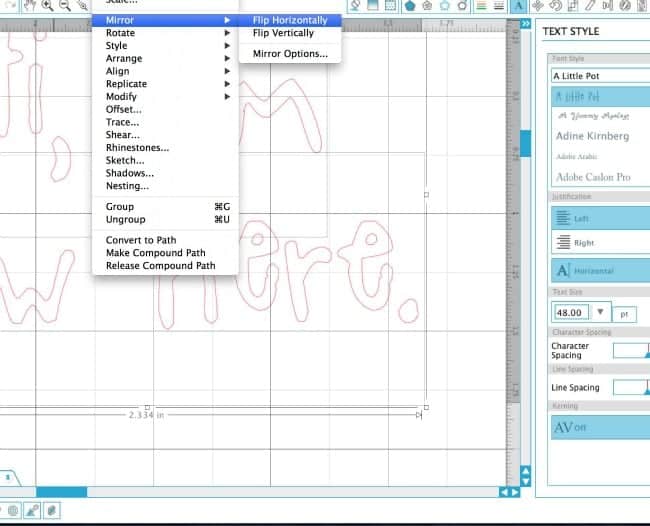
3. How do I create my design? If you are using a Silhouette Cameo or Silhouette Portrait, you will create your design in the Silhouette Studio Software. This is a free download that is available to play with even if you don’t have a machine yet, so even if you don’t have a machine yet feel free to play around and start creating designs! You can use images from the Silhouette Store or create your own one of a kind design. The most important tip to note here is that once you finish your design, you need to flip it into a mirror image. Because the design is flipped when you iron it on, it will ONLY come out facing the right way if you flip the image before you cut it. To do this:
Once you have your design created, select all design components.
Object
— Mirror
——–Flip Horizontally
4. How to cut your heat transfer. Once you have your design finished and flipped you are ready to cut. There are two ways to cut the heat transfer- with or without the cutting mat. I have found that if your design is small enough to fit on your cutting mat, that it is my preferred way to cut it. It just seems more secure and like there is less margin for error. However, if you are creating large designs or cutting multiple images in a row like I was for these party bags, you can cut the heat transfer from the roll without the cutting mat.
You will want to load your heat transfer material into the machine with the clear plastic backing facing down. The backing of heat transfer material will be facing up.
Start with the default cut settings for the type of heat transfer you are cutting and do a test cut. You should be able to see the cut on the heat transfer side, however, you might not be able to see the cuts if you turn the material over and look through the clear side. This is okay! Heat transfer material is VERY thin and the cuts will be very fine. I actually spent quite a long time on the phone with Silhouette because I was concerned it wan’t cutting through when the whole time it was cutting perfectly! Save time and learn from my mistakes!
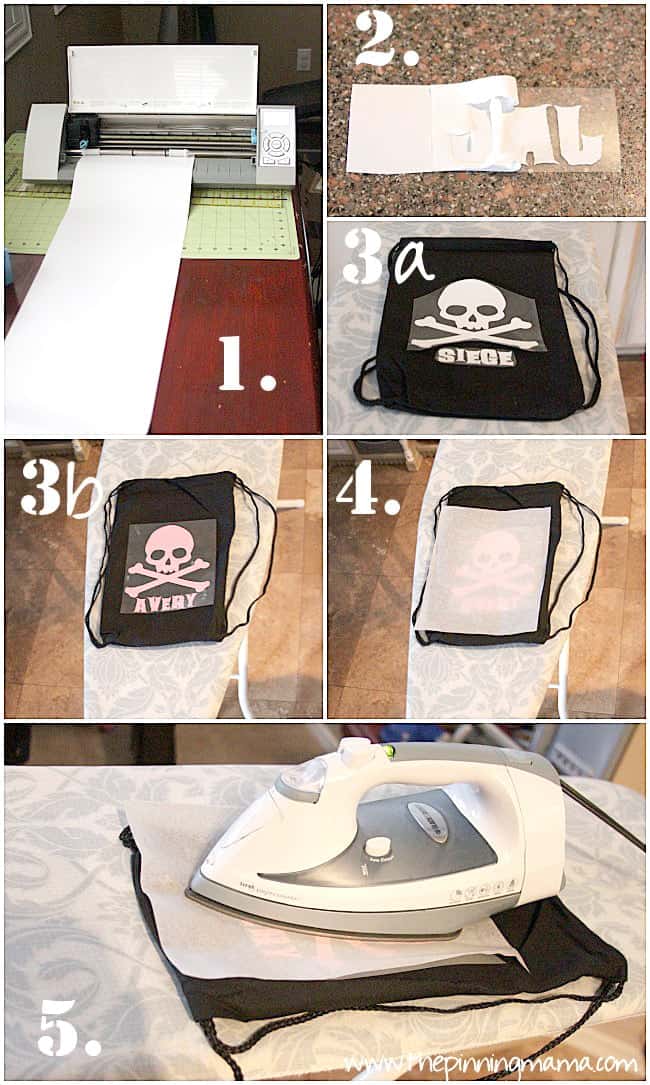
5. Weeding your heat transfer. Once your design is cut, you can trim around the design if there is extra around the edges like you can see in picture 2. Then you will want to peel off any parts of the design that you don’t want to be ironed on, or the negative space. You can use a weeding tool for this, or just use a safety pin. Make sure and get inside of any letters like A and O! When you are done you should have the design you want to transfer left stuck to the clear backing.
6. Arranging the design. We are getting closer! Take the weeded pieces of your design and place them clear backing side up on your project so they are aligned just as you want them. Since the clear backing is now facing up, your design should show just as it will be when it is finished, you should no longer be looking at a mirror image. If you designed and cut all of the pieces spaced just as you want them you should be able to place the the design on as one piece as in picture 3b. However if you compacted the elements of the design to save space while cutting, like I usually do, you can cut out the separate pieces and place them where you want them, like in 3b. The most important thing here is to make sure you have trimmed the clear backing pretty closely so that none of it ends up underneath other parts of the heat transfer.
7. Ironing the design on. Last but not least we get to iron! Read the directions on the back of your specific heat transfer, but most direct you to place your iron on a very hot setting. Mine also directed me to use a towel between the heat transfer and the iron. I found that this did not work as well as using a piece of parchment paper. I tried thin towels and thicker towels and no matter what the parchment just worked better.
Now you will want to put your hot iron on the design for between 10-40 seconds depending on the type, again read the directions for your specific heat transfer. Make sure that you are covering all of the edges of the design with the iron. You can release it and carefully pull up the backing to see if the design has stuck or needs to be heated more. I also found that on designs larger than the iron, it was easiest to iron the design in sections rather than going back and forth across the entire design.
Once the design has transferred I like to let it cool for about 30-45 seconds and then gently peel back the clear plastic until it is completely removed. I find that letting it cool for just a short bit helps because on smooth vinyl, if it gets too hot it can pull a little bit when you are removing the backing and cause wrinkles in the vinyl. Cooling a little seems to prevent this.
I tried to be very detailed and all inclusive in this tutorial beyond the basics of using the machine. I know when I was working on my first project with heat transfer I have a lot of simple questions that were usually grazed over in the tutorials I found online. If you are working on a heat transfer project and have a question I didn’t cover, please feel free to leave me a question in the comments! I would love to help!
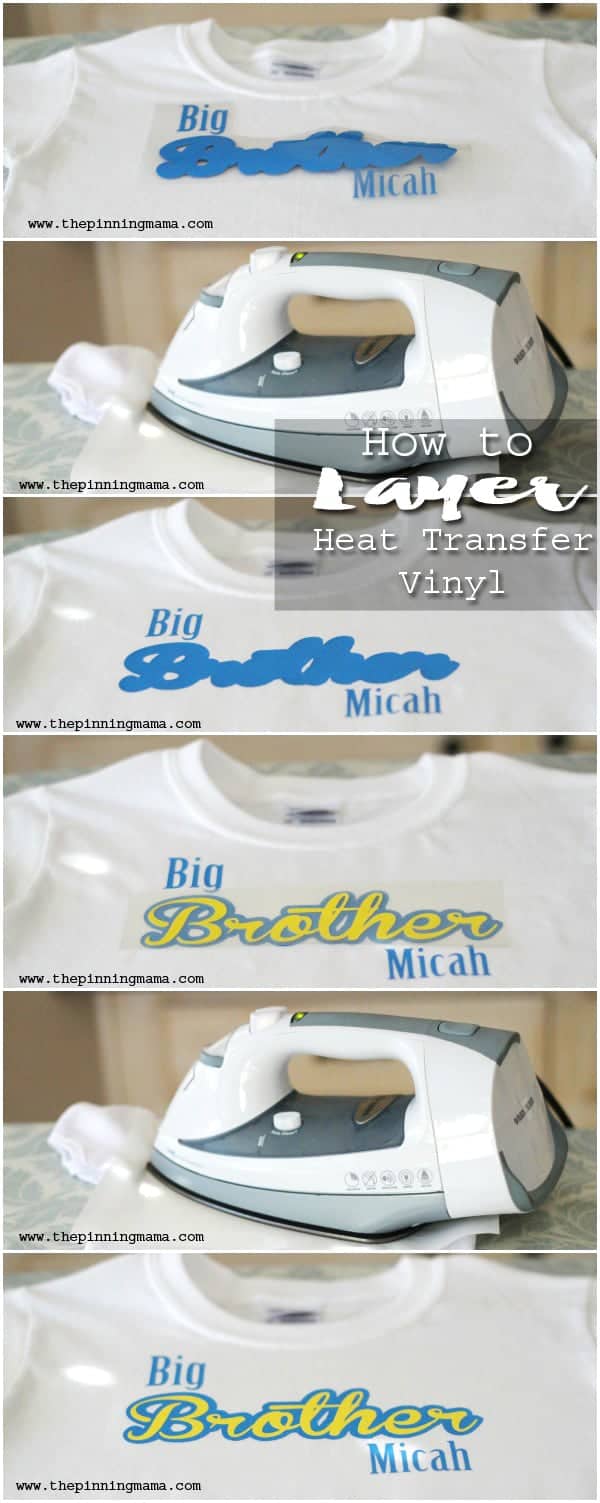
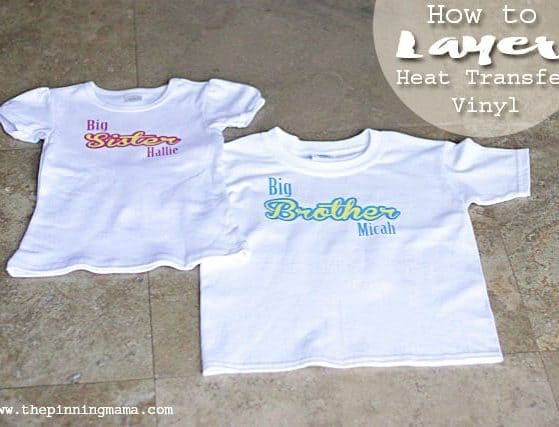
Here is another tutorial on how to layer Heat Transfer Vinyl for a fun multicolored look!
Make sure and check out my other posts to learn more and be inspired!! ——–> You can see more Silhouette projects and tutorials here.

Caty says
So smoothe HTV I haven’t had any issues with! However I just tried metallic gold (same company) and cannot get it to cut! I can see where it has cut, but not deep enough! I’ve cut it 3 times and when I peel it back the cut letters don’t come off! I even increased the thickness from 8 to 33 with no luck! Have you had this issue or should metallic be working the same??
Kacie says
Make sure you double cut on metallics!
Erica says
Any idea why my HTV would not stick to a 100% cotton t shirt? I have a heat press! It isn’t sticking at all…machine is on 375!
Kimber says
I have problems with 100% cotton too. I think it bonds better to synthetic fabric. If you can get the edge to stick and pull it little by little then you might can get it on. I usually do it this way then put the iron over it again after I pull it off the paper (with parchment )
Elaine says
i have had my Silhousette about a year and I can cut small things but I cannot cut out large fancy monograms. It cuts thru and tears . I ordered my heat transfer and it is different thicknesses. Some is very thick. I have wasted so much time and money but I can’t get my settings correct.
Katrina says
THANK YOU! I just made my son’s FREE HUGS Valentine’s shirt with the help of your post. It went together easily and I was able to problem solve every step with your advice. The parchment worked like a dream. Appreciate your help!
Kimber says
So glad it helped Katrina! It makes my day to get comments like this.
adeyemo Thaiwon says
How can i contact u when i want to buy my cutting and heating machine
Ashley says
I was wondering if anyone could tell me about doing multiple colors with the vinyl. I want to make a shirt for my son and it’s a quote and each line is a different color. Do I print and cut each line in the quote separately to achieve the different colored lines, and then if I do that how do I get it all to match up when I go to put it on the shirt? PLEASE help!!
Kimber says
Yes cut them each in the color they should be. I usually just trim each piece closely around the design and then eyeball it on the shirt. You can peel them up and move them around until you are ready to iron it on. If you want to be very exact about it, then you could use a fabric pen to mark the middle and then line it up to that.
Kathryn says
When storing and traveling with heat transfers, what is the best material to put on the backside so the transfer tape does not stick to other things? Thank you!
Kimber says
I have never travelled with heat transfer before, but I would probably just cut the design and wait to weed it until I got to the destination – OR- buy some cheap dollar store contact paper and use the backing of it to stick to the sticky transfer tape to keep it fresh until you get there. Hope that helps!
Shonah says
Yay! Perfect timing for me. Was just going to make a few things for an up and coming trip and was wondering how to go about this. Thanks!
http://partnparcelstudio.com/
PAM WINNERS says
Hello,
I made a couple t-shirts using the silhouette brand heat transfer and I had one heck of a time getting it to adhere to the t-shirt. I was finally successful but the first time I washed the shirts the letters started falling off 🙁 I turned them inside out, washed on cold, followed all the manufacturers instructions and the project was still a failure. Any tips or ideas?
Kimber says
Hi Pam- I have found that the more synthetic blend the shirt is the better the HTV adheres. I have also had a hard time with 100% cotton shirts (and baby onesies!) Check to see if your shirts are 100% cotton and that might solve your issue. Hope that this helps!
Marco says
Hi! Thank you for coming up with a very informative and helpful tutorial. I’m starting a project and I’d like to use this method. However, I learned that when washing an item with the design already transferred on it, the design would peel off or bleed. What can you do to prevent this from happening?
Thank you!